FILIPINO EXOTIC FOOD:BALUT

Resulta ng larawan para sa balut                    Balut is developing bird embryo that is boiled and eaten from shell.It originated from and commonly sold as street food in the philippines.Often served with beer,and balut is popular in southeast asia.. Once you’ve cracked the egg and peeled a bit of the top off, you’ll encounter a clear broth so savory that there are people who only drink that and leave the rest of the egg. But if you’re game to move on, you can add a little salt or vinegar and drain the soup before eating it. Some people peel and bite in increments to avoid actually seeing the small duck HAHAHA, while others just peel off most of the shell and eat the balut in one or two bites.

Many people afraid to try balut don’t want to feel like they’re chewing on a duckling. In fact, the experience of eating balut is quite pleasant. A good balut yolk has a soft texture not unlike cream cheese. It’s not as sulfurous as regular hard-boiled chicken eggs. A good balut, including the embryo, is milder in flavor, and there’s nothing to be afraid of when it comes to the embryo’s texture. You’re not crunching through bones—it’s tender and dissolves in your mouth,                                                                                                                                Not everyone eats balut in the philippines,also some filipinos didn’t want to try balut because it stink sometimes and the duck looks a live.Balut’s are really common here at thr philippines,because when it comes in street food talks,balut is the first thing that sink to their mind.balut/balut vendor ussually found in streets,transportations,wet markets,but in province they’re are just using bike or sometime they walk  bringing with a small basket so that they can go everywhere just to sell it. Resulta ng larawan para sa balut

POPULAR ILOCANO DISH:IGADO

IGADO is a popular dish from ilocos region made from pork tenderlion and pig innards.it is cooked in a vinegar-soy sauce mixture that is sure to bring out unique and one of a kind flavors. . This is definitely one of the best Filipino foods around specially in any occasions

I’m not sure where the name “Igado” was derived from.this is almost perfect.However ,the authentic ilocano requires  negative garlic and sukang iloco and a little of ilocano bagoong(fish)sauce.

since this dish came from pig’s innards,its better nor important ofcourse to make sure that thee ingredients that you are using are all clean.my mom usually clean the ingredients (liver,kidneys,etc.)  with running water or mineral water before slicing it.As of the kidneys,i soak it in water with salt for 10 to 15 minutes after slicing it in order to reduce the odor or  so thet it wont stink when you eat it


LUMPIANG SHANGHAI

Lumpiang Shanghai filled with ground chicken, water chestnuts, carrots, and green onions. Golden, crisp and in fun bite-size, these Filipino meat spring rolls are absolutely addicting!

Lumpiang Shanghai filled with ground chicken, water chestnuts, and green onions. Golden, crisp and in fun bite-size, these Filipino meat spring rolls are absolutely addicting!

Lumpia shanghai are a popular in Filipino food gatherings and special occasions. In fun bite sizes and served with sweet,sour sauce and if you want a spicy one why not right? , they’re the perfect appetizer!

These Filipino spring rolls are usually filled with a mixture of ground chicken or pork, chopped vegetables such as carrots,  onions, and jicama, and occasionally, minced shrimp. In my version, I use minced garlic to heighten flavor, chopped green onions for color, and water chestnuts for texture.YUM YUMMY

SUPER SPICY BICOL EXPRESS!

Bicol Express is pure comfort food! With pork cubes cooked in coconut milk and chili peppers, it’s rich, creamy, spicy and delicious! Serve with steamed rice for a hearty meal!

Bicol Express is pure comfort food! With pork cubes cooked in coconut milk and chili peppers, it's rich, creamy, spicy and delicious! Serve with steamed rice for a hearty meal!

The day after I made my very first gising-gising, I packed half of it to work for one of my co-workers to try. She is from Bicol and I was interested to know what she thought of my newfound recipe. Alas! Instead of the rave review I expected, she barely touched the portion I ladled on her plate.

The next day in the break room, she plopped a big Tupperware in front of me and said,  “This is how you do spicy. Go big or go home.”  Oh. My. Gaawwd! Her Bicol express was so viciously hot I couldn’t feel my tongue after each bite and yet it was so deliriously good I kept digging in for morE!

Pork Bicol Express is a rich, creamy, and spicy Filipino dish perfect with steamed rice. It's pure comfort food!

I used about 14 reasonably large Thai chili peppers (siling labuyo) to make this pork Bicol Express and the result is certainly not one for the meek. If you want to temper the heat a bit, use less amount of chilis from what is called for in the recipe or scrape the seeds off the pepper pods before mincing. Either way, hot or mild, make sure to have plenty of steamed rice ready!

Tips on Making Bicol Express:

  • If you’re using raw shrimp paste instead of the

    sauteed shrimp paste recommended in the recipe, make sure to brown it a few minutes longer to rid of the “fishy” smell and taste.

  • Coconut milk tends to curdle or separate when brought to a boil or heated too quickly. Cook in a gentle simmer to ensure a smooth, creamy sauce . As you can see from our nutritional facts below, this recipe is not exactly waist friendly. Unfortunately, the succulent pork belly cubes and rich, creamy coconut sauce we love come with a price. If you want to trim down some of the fat, swap the belly with a leaner cut such as pork shoulder. You can also sub the pork with boneless, skinless                                                                                            ONE OF MY FAVORITE DISH!YOU MUST TRY THIS ONE TOO

FILIPINO STEW:DINUGUAN

Dinuguan is a Filipino stew made of pork meat cooked in pig’s blood, vinegar and spices. Offal parts are traditionally used in this rich and spicy dish but since I was able to intrigue G enough to give it a try, I  used pork belly to tame the fear factor. He already has to wrestle with the idea of eating pork blood and to add bits and pieces of ears, snouts, stomach and kidneys into the mix might be too much for the poor guy to handle in one sitting.

Dinuguan

I prefer vinegar in my dinuguan but I’ve tried versions which use tamarind, kamias or even tomato sauce as the souring agent. Regardless of what you choose to use, these acids serve the same purpose. Along with adding the necessary touch of sourness to the dish, they also keep the blood from curdling. Make sure to stir about one or two tablespoons of the vinegar in the pork’s blood before adding to the stew to ensure a smooth, deep brown sauce. The brown sugar added during the last few minutes of cooking might seem out of place in this rich, savory dish but it does pull all the flavors together nicely. Give this dinuguan a try tonight and let me know what you think.                        YOU NEED TO TRY THIS ONE!

HEALTHIEST FILIPINO SOUP

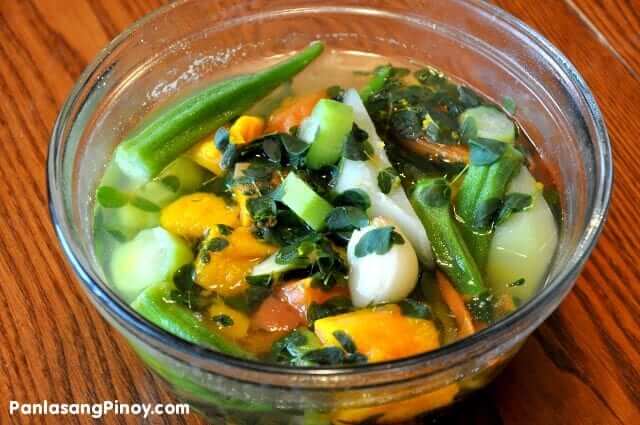
Bulanglang is a healthy dish consisting of different types of vegetables. There are different versions of Bulanglang; this particular recipe is the version from the province of Batangas.Making Bulanglang is quick and easy; all you need to do is boil water or rice washing (water used to clean rice) and put-in the vegetables according to their cooking time. Thick and hard vegetables such as calabaza squash (kalabasa) and green papaya should be boiled first, while soft green vegetables like malunggay should be added last.

Bulanglang Recipe

This is probably the healthiest Filipino soup because of the combination of different kinds of vegetables. Having a serving of Bulanglang can supply most of your body’s daily needed vitamins and minerals. As for the taste, this dish has a very mild and simple taste. The flavors are derived from the vegetables alone. You can try adding a little salt to enhance the flavor. Some people make a dip consisting of fish sauce (patis), birds eye chili (siling labuyo), and calamansi to add more flavor. If you want to try this dish to avail of its health benefits, I suggest that you take it easy on the salt and fish sauce.

Although there are common vegetables used to make this dish, you can modify the recipe by using the vegetables that appeal to you.

PINOY’S FAVORITE BREAKFAST:TAPSILOG

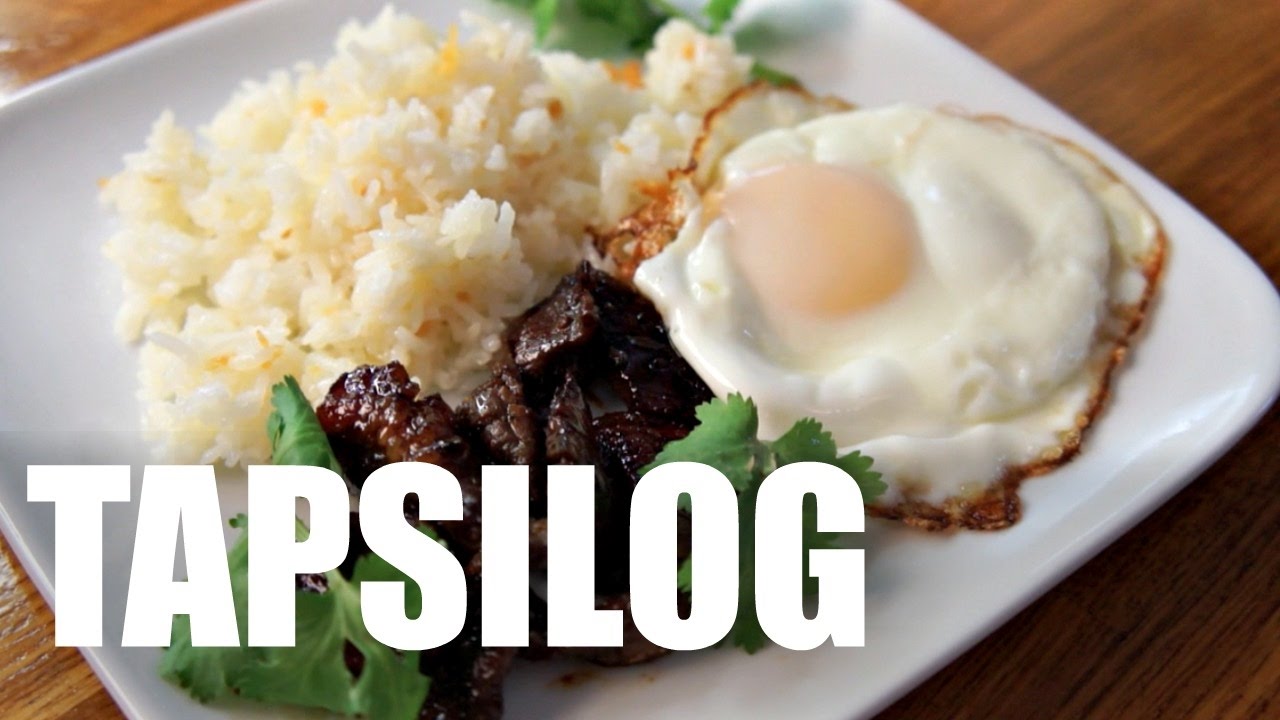
TAPSILOG is one of the filipino’s favorite for breakfast !

Tapsilog is a meal composed of Filipino beef jerky, garlic fried rice, and fried egg. The name was derived from the ingredients. The beef jerky is known as “Tapa”, garlic fried rice is called “Sinangag”, and the Filipino term for egg is “Itlog” – thus TapSiLog.

Tapsilog is a popular meal in the Philippines. The meal is commonly consumed during breakfast. However, it can be consumed anytime of the day or night. due to the existence of several eateries (these are known as Tapsihan or Tapsi House) and/or restaurants serving this food. There are even 24-hour eateries that serve Tapsilog along with other delicious dishes such as Tosilog, Arroz Caldo, and Goto.

This Tapsilog recipe is a combination of our homemade beef tapa recipe and sinangag recipe. I think that most of you does an awesome job in frying eggs, so I did not cover the “How to fry an egg” part.

Resulta ng larawan para sa TAPSILOG

MOST POPULAR DISH:ADOBO

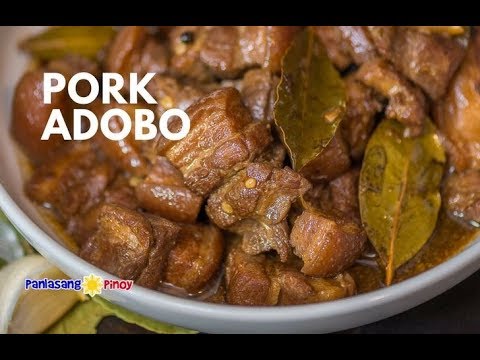
While the adobo dish and cooking process in Filipino cuisine and the general description of adobo in Spanish cuisine share similar characteristics, they refer to different things with different cultural roots. While the Philippine adobo can be considered adobo in the Spanish sense—a marinated dish—the Philippine usage is much more specific to a cooking process (rather than a specific recipe) and is not restricted to meat. Typically, pork or chicken, or a combination of both, is slowly cooked in vinegar, crushed garlic, bay leaves, black peppercorns, and soy sauce. It is served with white rice. It was traditionally cooked in small clay pots (palayok or kulon); but in modern times, metal pots or woks (kawali) are used instead.

There are numerous variants of the adobo recipe in the Philippines. The most basic ingredient of adobo is vinegar, which is usually coconut vinegar, rice vinegar, or cane vinegar (although sometimes white wine or cider vinegar can also be used). Almost every ingredient can be changed according to personal preference. Even people in the same household can cook adobo in significantly different ways. A rarer version without soy sauce is known as adobong puti (“white adobo” or “blond adobo“), which uses salt instead, to contrast it with adobong itim (“black adobo”), the more prevalent versions with soy sauce.Adobong puti is often regarded as the closest to the original version of the Pre-Hispanic adobo. It is similar to another dish known as pinatisan, where patis (fish sauce) is used instead of vinegar.

giving the dish a distinct yellowish color (known as adobong dilaw, “yellow adobo”).


Adobo has also become a favorite of Filipino-based fusion cuisine, with avant-garde cooks coming up with variants such as “Japanese-style” pork adobo.                                                                                                                                                                                                                                                                                                                                                                                                            Resulta ng larawan para sa ADOBO

KARE KARE RECIPE

hqdefault (2)

Kare Kare is a traditional Filipino stew complimented with a thick savory peanut sauce. The commonly used meats for this dish are ox tail, tripe, and pork leg; on some occasions goat and chicken meat are also used. Besides the peanuts, this dish depends on the shrimp paste (on the side) in order to be fully enjoyed. Traditionally, “palayok” (clay cooking pot) is used to cook this dish and it is also used as the serving pot. his perennial Filipino favorite usually starts with a base of oxtails, beef stew cuts, pork hocks or tripe. Traditionally, the choice meat is simmered for hours to desired tenderness and and along with a variety of vegetables such as banana heart, long beans and eggplant, it’s pulled together into a stew with ground peanuts for flavor, toasted ground rice for thickening  and annatto for coloring. Because of the dish’s very involved cooking process, it is usually reserved for special occasions but by using convenient rice flour and peanut butter, it is simplified enough to be everyday dinner-friendly. Give this a try, my friends, or browse our recipe index for more delicious meal ideas. Thank you for all your lovely comments. Truly appreciated.

INSTRUCTION

  1. Rinse oxtail under cold, running water and with a knife, trim excess fat. In a deep pot, place oxtails and enough water to cover. Over medium heat, bring to a boil, skimming any scum that accumulates to top. Lower heat, cover and simmer, adding more water as needed to maintain 6 cups, for about 2 to 3 hours or until oxtails are easily pierced with a fork. Drain oxtail, reserving about 6 cups broth.

  2. Peel and discard the outer, fibrous skin layers of banana heart until you reach the lighter, softer core. Trim off stem and discard. Cut banana core into half and into fourths. In a bowl of cold salted water, place cut banana and soak for about 15 to 20 minutes. Using hands, squeeze to release bitter sap. Rinse with cold water and drain well, discarding liquid.

  3. In a pot over medium heat, bring about 4 cups water to a boil. Add banana heart and blanch for about 1 minute. With a slotted spoon, remove from liquid and set aside. Add eggplant and blanch for about 1 minute. With a slotted spoon, remove from liquid and set aside. Add long beans and blanch for about 1 minute. With a slotted spoon, remove from liquid and set aside. Add pechay and blanch for about 30 seconds. With a slotted spoon, remove from liquid and set aside.

  4. In a skillet over medium heat, add rice flour and cook, stirring occasionally, until lightly browned and toasted. In a bowl, combine toasted rice flour and ¼ cup reserved broth and whisk until smooth.

  5. In a small bowl, combine annatto powder and ¼ cup reserved broth. Stir until powder is dissolved and color has dispersed.

  6. In a bowl, combine peanut butter and ½ cup of reserved broth and stir until well-blended.

  7. In a large pot over medium heat, heat oil. Add onions and garlic and cook until limp and aromatic. Add oxtail and cook, stirring occasionally, until lightly browned. Add fish sauce and cook for about 2 to 3 minutes.

  8. Add the remaining 5 cups of reserved broth and bring to a simmer. Add annatto water, rice flour mixture and peanut butter mixture, stirring well to combine. Season with salt and pepper to taste. Continue to simmer for about 10 minutes or until it begins to slightly thicken. Add blanched vegetables and cook for about 2 to 3 minutes or until heated through and tender yet crisp. Serve hot with shrimp paste on the side

More Good Food!


FILIPINO DISH:SISIG


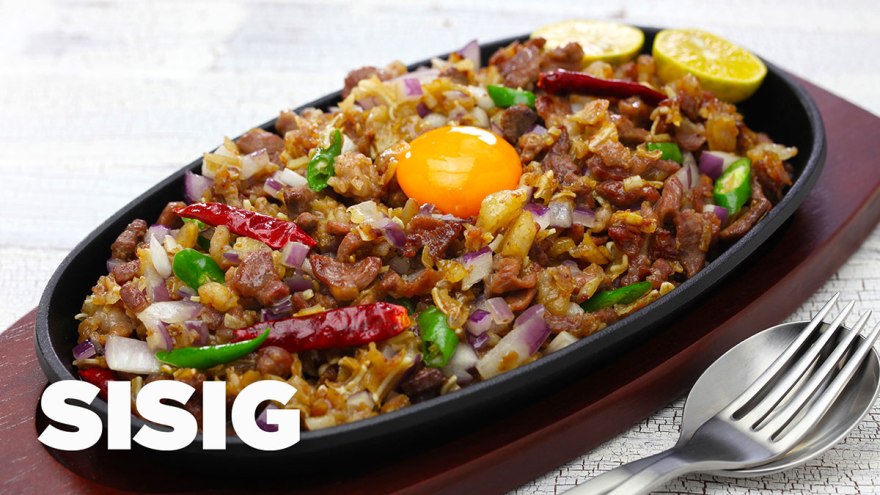
Sisig is a Filipino dish made from parts of pig head and liver, usually seasoned with calamansi and chili peppers.

Sisig was first mentioned in a Kapampangan dictionary in the 17th Century meaning “to snack on something sour” and “salad”. It usually refers to fruits, often unripe or half-ripe, sometimes dipped in salt and vinegar. It also refers to a method of preparing fish and meat, especially pork, which is marinated in a sour liquid such as lemon juice or vinegar, then seasoned with salt, pepper and other spices.

his pork sisig is more of the restaurant variation wherein mayonnaise is used and an egg is added on top, along with chopped green onions, but it sure tastes great. The original pork sisig recipe makes use of pig brain as a binder – we used the mayo as a alternative ingredient. Don’t worry, I’ll be posting the original recipe soon along with a video to better guide you.

There are several restaurants and even eateries and “carenderia’s” that serve this wonderful dish. It has been very popular to the point that it is available almost all over the world. I know that we all have our own favorite places that serve pork sisig, but it is still good to know how to make one for many reasons. I make my own pork sisig because I get to play with the ingredients and outcome of the dish. I am also assured that the ingredients were properly handled prior to cooking. This is also something that you can brag – or share with  your friends.

filipino-food-sisig